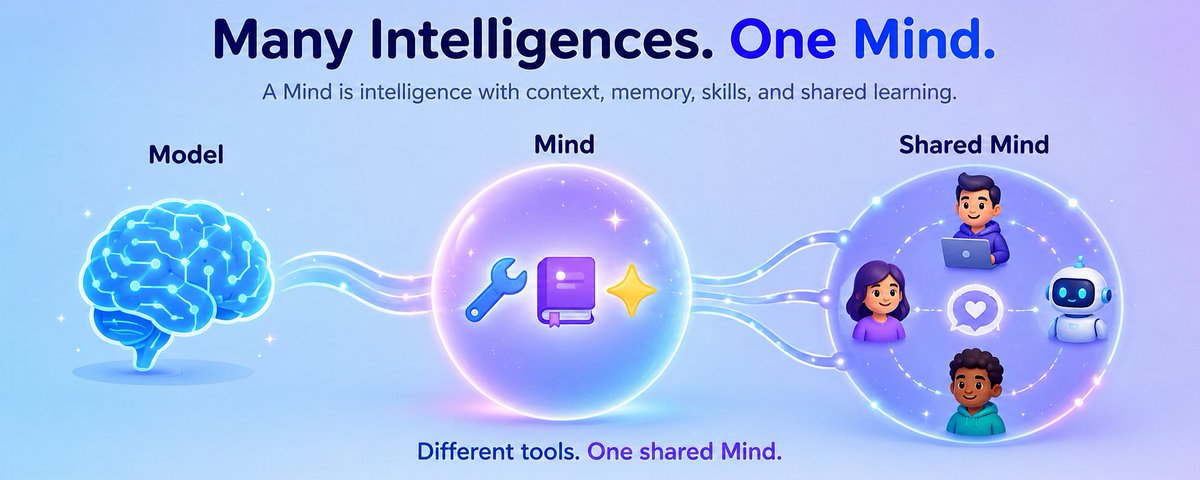
AI is becoming dramatically more capable.
But an AI today is no longer just an LLM.
We start with a model, then give it a shell. We add system prompts, tools, skills, memory, files, workflows, harnesses, and ways to learn from previous work.
Put all of these together, and you get something bigger than intelligence alone.
We call it a Mind.
Intelligence is not a Mind
Think about a human.
Having intelligence means you have a functioning brain. But your brain alone does not define who you are.
Throughout your life, you learn.
You are trained.
You develop skills.
You accumulate memories and experiences.
You learn how to use tools.
You form habits, rules, preferences, goals, and ways of thinking.
Eventually, you develop answers to questions like:
Who am I?
Where do I come from?
What can I do?
What have I learned?
What do I believe?
Where do I want to go?
That is your Mind.
AI is starting to develop in the same direction.
An LLM provides intelligence.
But an AI that can actually work needs much more around that intelligence.
Its Mind might include:
- the model it uses,
- its system and internal prompts,
- the tools it can access,
- the skills it has learned,
- its memory,
- the files and knowledge it can read,
- the rules it must follow,
- the workflows it understands,
- the harness that shapes how it works,
- and the experience accumulated from previous tasks.
The model can be replaced.
Tools can change.
Skills can improve.
Memory can grow.
Experience can accumulate.
The Mind evolves.
We are already building Minds
Look at how modern AI products are evolving.
At first, we mostly talked directly to an LLM.
Then we gave it tools.
Then code execution.
Then memory.
Then MCP servers.
Then skills.
Then agents.
Then subagents.
Then increasingly sophisticated harnesses that determine how an AI plans, searches, calls tools, checks its work, learns, and collaborates with other agents.
We keep adding things around the model because raw intelligence is not enough to do real work.
A brilliant model with no context can still be a terrible teammate.
A slightly weaker model with the right tools, skills, memory, rules, and experience can sometimes perform much better.
The industry usually talks about these pieces separately:
Prompt engineering.
Context engineering.
Agent engineering.
Harness engineering.
Memory.
Skills.
Tools.
But from another perspective, they are all parts of the same thing:
we are constructing Minds around artificial intelligence.
But having a Mind is not enough
Now consider another question:
How do humans align their Minds?
We talk.
We debate.
We have meetings.
We write documents.
We teach each other.
We review each other's work.
We make decisions together.
And through all of these interactions, one person's understanding can become shared understanding.
Now ask the same question about AI:
How do AIs align their Minds?
Today, the answer is surprisingly primitive.
Someone commits an AGENTS.md file to Git.
Someone maintains shared Cursor rules.
Someone writes a document.
Someone posts a decision in Slack.
Someone manually tells their AI what happened in a meeting.
Someone remembers to update one tool but forgets another.
In other words, the human behind each AI is still responsible for keeping that AI's Mind aligned with the team.
And that breaks very quickly.
An AI may be incredibly intelligent.
It may know how to write code, analyze markets, design interfaces, or create strategies.
But it can still start work knowing almost nothing about the team it is supposed to work with.
It does not automatically know:
- what the team is building,
- why previous decisions were made,
- which standards must be followed,
- what has already been tried,
- which ideas were rejected,
- how the organization prefers to work,
- what another AI discovered yesterday,
- or what other humans and AIs have already learned.
Its intelligence may be excellent.
Its Mind may even be powerful.
But its Mind is not aligned with the team.
And every AI in the organization may be operating with a different Mind.
A shared Mind for humans and AI
Imagine a product team.
A designer works with an AI and develops a better interaction pattern.
That knowledge becomes part of the Project Mind.
A senior engineer establishes a new architecture boundary.
That becomes part of the Project Mind too.
The product manager changes the product strategy.
The Mind changes.
An AI discovers that a technical approach fails under a particular condition.
That experience can become part of the Mind.
Then another developer opens Codex.
The relevant design standards and architecture boundaries are already available.
Another teammate uses Cursor.
It receives the same project knowledge in the format Cursor understands.
Someone else uses Claude Code.
Claude receives the relevant part of the same Mind.
A new engineer joins six months later.
Their AI does not start from zero.
It already has access to what the team has learned.
This creates an important shift:
knowledge stops belonging to a person, an AI session, or a specific tool.
It becomes part of the organization.
And when the organization learns something, its humans and AIs can learn together.
A Mind is not a big prompt
This distinction matters.
You can put a huge amount of information into one prompt.
That does not make it a Mind.
A real Mind has structure.
It knows where knowledge comes from.
It changes over time.
It accumulates experience.
It has history.
It has permissions.
It understands scope.
It connects knowledge to actions.
And it can deliver the right context to the right intelligence at the right time.
For an organization, a Mind therefore needs to be:
Living.
It evolves as humans and AIs learn.
Versioned.
You can understand what changed, when it changed, and why.
Shared.
Humans and AIs can contribute to the same organizational understanding.
Scoped.
An organization, team, project, person, and AI can each have different layers of knowledge.
Permissioned.
Not every person or AI should know or change everything.
Composable.
A Project Mind can inherit from a Team Mind or Organization Mind while developing its own knowledge.
Portable.
Knowledge should survive when models and AI tools change.
Active.
It should not merely store information. It should participate in work.
Aligned.
When something important changes, the Minds that depend on it should be able to change with it.
From AI agents to AI organizations
The first generation of AI was mostly:
Human ↔ LLM
Then we moved toward:
Human ↔ Agent
Now we are entering something much bigger:
Many humans ↔ many AIs ↔ many tools
At that scale, giving every AI a better prompt is not enough.
Giving every AI individual memory is not enough.
Building better agents is not enough.
Even giving every AI its own powerful Mind is not enough.
Because the real challenge becomes:
How do all of these Minds work together?
The organization itself needs memory.
It needs skills.
It needs standards.
It needs experience.
It needs mechanisms for learning.
It needs mechanisms for alignment.
It needs to know what it knows—and make that knowledge available to the right intelligence when it matters.
In other words:
the organization needs a shared Mind.
This is what we are building at onemind.
Not another chatbot.
Not another AI coding interface.
Not another prompt manager.
onemind is a shared intelligence layer where the Minds of humans, AIs, projects, tools, skills, knowledge, decisions, and experience can connect, align, and evolve together.
Because AI-native organizations will not have one intelligence.
They will have many.
And the real advantage will not come from having the smartest individual AI.
It will come from whether all of those intelligences can learn together, stay aligned, and work as one organization.
Many intelligences. One Mind.