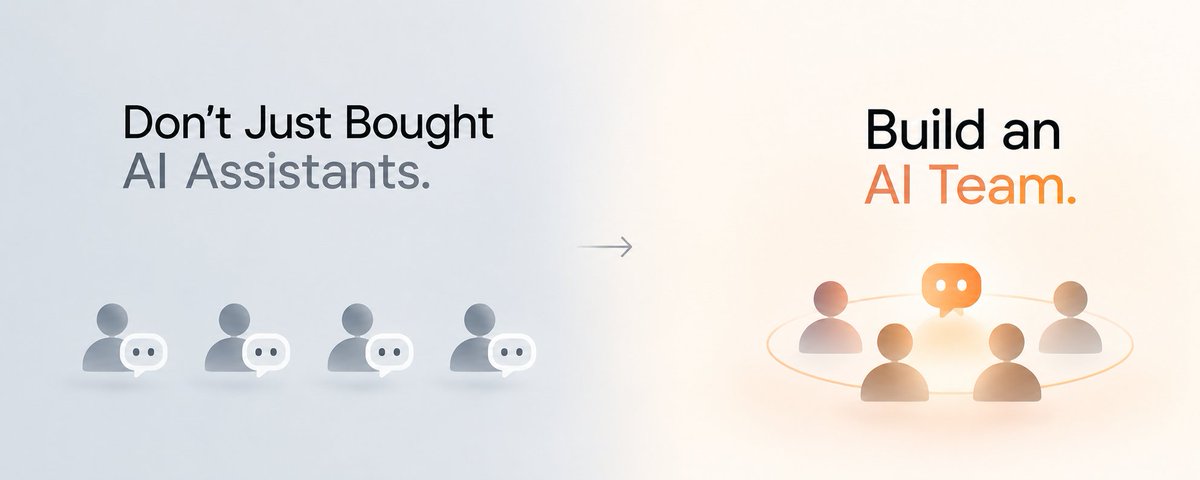
Your company bought ChatGPT subscriptions. Claude seats. Cursor licenses. Codex usage. API tokens.
Then you gave them to employees and said:
Use AI. Be more productive.
And, to some extent, it worked.
Developers wrote code faster. Designers explored more ideas. Product managers drafted specifications in minutes. Marketers produced more campaigns.
Everyone got a capable assistant.
But did the company become a more efficient organization—or did it simply buy more production capacity?
Those are not the same thing.
You gave AI to the people in your team. You didn’t necessarily make AI part of the team.
More output is not the same as more efficiency
Producing more work is valuable. But the goal of a company is not to produce as much code, documentation, or design as possible.
It is to turn coordinated effort into useful results.
Consider a team building a new feature.
The designer uses AI to update the interface. The developer uses AI to implement it. The marketer uses AI to prepare the launch.
Each person "finishes" their part faster.
But the developer’s AI follows an outdated design standard. The marketer’s AI describes a capability that was removed from the plan. And the designer’s AI proposes an interaction the team already rejected for technical reasons.
Now the team has to reconcile everything.
More review. More explanations. More revisions. More time. More token. More costs.
The individual tasks became faster. The work between those tasks did not.
You can improve the speed of every contributor without fixing the friction between them.
That is the gap an AI subscription alone does not close.
The AI is connected to the employee, not the team
Look at the structure behind this kind of deployment.
A developer opens Codex. A designer talks to Claude. A product manager uses ChatGPT. A marketer starts another conversation somewhere else.
Each AI may have useful context. But that context depends on what its human provides, what its tool can access, and whether that information is current.
The developer’s AI knows the architecture. The designer’s AI knows the visual guidelines. The product manager’s AI knows why a feature was rejected. The marketer’s AI knows the latest positioning.
But these pieces of knowledge do not automatically become shared team knowledge.
When a decision changes, who makes sure the relevant AIs receive it?
When someone discovers a constraint, who carries it into everyone else’s tools?
When a new person joins, who reconstructs the context their AI needs?
Too often, the answer is: the human behind each AI.
The employee becomes the connection between their assistant and the organization. They copy decisions into prompts, update local instructions, attach documents, and explain what changed.
The AI can help with the work. But its human still has to carry the team’s memory into the conversation.
The biggest mistake: buying intelligence without integrating it
Imagine hiring an engineer, giving them a powerful computer, and immediately assigning work.
You never introduce them to the team’s goals. You do not explain the architecture, provide the current standards, or show them which approaches have already failed.
Whenever they need context, someone gives them a few fragments.
When they make a mistake, you explain the missing information.
Then, on the next assignment, you repeat the process.
You would not call that engineer properly onboarded.
Yet an AI deployment can end up working exactly this way.
Access is treated as onboarding. A subscription is treated as integration.
But giving someone a tool is not the same as giving that tool a working relationship with the organization.
Employees who already understand the company can compensate. They know which instructions to provide, which documents matter, and when an answer conflicts with an earlier decision.
New employees cannot reliably supply context they do not yet have.
Instead of making organizational knowledge easier to use, the deployment can preserve the same old dependency: your AI is only as informed as the person responsible for keeping it informed.
More tokens cannot fix a missing connection
A stronger model may reason better. More tokens may let it do more work. A larger context window may let it consider more information.
Those improvements matter.
But none of them, by itself, tells the AI that the team changed a requirement yesterday.
A larger context window is not a process for keeping context current.
A longer-running agent is not a mechanism for coordinating with other contributors.
And another subscription is not shared organizational memory.
If the missing ingredient is a team decision, more reasoning over outdated information does not supply it.
The question is not just:
How much intelligence can we afford?
It is also:
How does that intelligence learn what our team knows—and stay aligned as that knowledge changes?
Until there is a reliable answer, increasing AI capacity leaves the underlying coordination problem unresolved.
What makes an AI a teammate?
Calling an AI a teammate does not require pretending it is human. It does not mean giving it unrestricted access or letting it make every decision.
It means integrating its work into the team’s shared goals, knowledge, and responsibilities.
That requires more than a good prompt.
A shared starting point.
The AI should have access to the relevant project goals, standards, constraints, and approved decisions—not depend on someone remembering to include them in every task.
Continuity.
The team should not lose important context when a conversation ends, a contributor changes tools, or another AI takes over. The work should continue from what the team has already learned.
Clear responsibilities and boundaries.
The AI needs to understand its task, what it may access or change, when approval is required, and what a completed handoff should contain. Being part of the team does not mean knowing everything or acting without oversight.
A way to contribute back.
An AI may discover a useful constraint, identify an outdated rule, or propose a better approach. That contribution should be available for review and, when approved, become part of the team’s shared knowledge. A suggestion should not silently become company policy.
Shared context is not the whole of teamwork. But it is a foundation for making responsibilities, review, and coordination work.
The human should still direct and evaluate the AI’s work.
They should not have to act as a manual synchronization service between every conversation and the rest of the company.
From personal intelligence to organizational intelligence
Giving every employee an assistant addresses one question:
How can this person work better?
An AI-native organization must also address another:
How can humans and AIs work better together?
The first question leads to better individual tools.
The second requires shared organizational infrastructure.
Project context cannot live only in one person’s conversation. Decisions cannot remain useful only to the people who attended the meeting. Standards cannot depend entirely on someone remembering to copy the latest version into a local file.
The team needs a shared source of context that can evolve with the work.
Not a giant prompt containing every company document. Not identical instructions for every AI.
The right context, at the right scope, with a clear distinction between what is proposed, what is approved, and what is current.
The model can change. The tool can change.
The team’s memory should not have to start over.
This is why we are building onemind
onemind starts from a simple belief:
AI should not just work for a person. It should work as part of an organization.
We call the shared, versioned organizational memory a Mind: the goals, rules, skills, decisions, and knowledge that humans and AIs need to work from.
onemind connects that Mind with the people, AI members, projects, and tools that use it.
Our starting point is AI coding workflows, where the problem is concrete. Project context needs to be reviewed, versioned, and delivered to connected tools—not repeatedly reconstructed by every developer and every agent.
The goal is not to make everyone abandon their preferred tools.
It is to let them keep those tools without keeping the team’s knowledge trapped inside them.
An approved architecture decision should be available to the relevant coding agents. A revised standard should not depend on every teammate manually copying it. A handoff should preserve what matters about the work, not force the next contributor to rediscover it.
That is the shift we are building toward: from separate assistants serving individual employees to connected intelligence working as part of one team.
Buying AI access is a starting point.
But the goal is not simply to generate more work.
It is to make the whole team work better.
Many intelligences. One Mind.